01 // Core Mission

Structured Case Management for Pharmacovigilance and Toxicovigilance

BlueSentinel is built for the teams who receive, assess, validate, and close adverse event cases, in health agencies, poison control centers, and pharmaceutical companies.

It covers pharmacovigilance and toxicovigilance in a single environment, with AI-assisted clinical assessment and structured medical governance.

02 // Architecture

A modular architecture built on a single source of medical truth

Health vigilance work depends on two distinct but inseparable requirements: access to reliable, structured medical and scientific knowledge, and the ability to manage individual cases with full clinical rigor and traceability.

Most systems address one or the other. BlueSentinel addresses both, in a single integrated environment, where the knowledge base directly informs clinical assessment, and where every case action is governed, logged, and auditable.

The platform is structured around two modules. BlueMap is the knowledge foundation. BlueLine is the operational layer.

BlueMap

The knowledge foundation

Clinical vigilance is only as reliable as the knowledge it draws on. BlueMap is the structured medical and scientific knowledge base at the core of BlueSentinel. It combines internationally recognized pharmacological and toxicological references with institution-specific data, local exposure profiles, regional substance registries, center-specific terminology, and connects via API to external epidemiological databases.

What makes BlueMap distinctive is its ability to transform an institution's own case history into exploitable knowledge: patterns accumulated over years become searchable, retrievable, and active at the moment of clinical decision-making. For institutions building or consolidating their vigilance capacity, BlueMap is available as a standalone module.
BlueLine

From first report to validated case closure

BlueLine manages the full lifecycle of an adverse event case, from the moment it is reported to the moment it is formally closed and ready for submission to national authorities or to the WHO PIDM. Built on BlueMap's knowledge base, it guides clinical teams through a structured workflow. AI-assisted hypothesis generation surfaces relevant substance-symptom associations and imputability considerations directly within the case interface, the clinician reviews, confirms, or dismisses each suggestion before the case advances.

For institutions building toward stronger vigilance governance, BlueLine provides the operational foundation that regulatory maturity is built on, designed around ICH and CIOMS standards for case management, clinical accountability, and audit readiness.
03 // Solutions

BlueSentinel serves each context

Health vigilance is not a single practice. A national medicines agency managing spontaneous adverse drug reaction reports operates under different constraints than a poison control center receiving toxicological emergency calls, or a pharmaceutical company fulfilling its post-marketing safety obligations. BlueSentinel is designed to serve each of these contexts, not through separate products, but through a single platform whose architecture accommodates different roles, workflows, and governance requirements.

National health agencies & ministries of health

National pharmacovigilance centers carry population-level safety obligations that rarely come with proportionate resources. BlueLine's structured workflow reduces the cognitive and administrative load on each case, AI-assisted assessment surfaces relevant clinical associations directly within the case interface, so that clinical expertise is applied to decisions, not to documentation. BlueMap's knowledge base, enrichable with local pharmacological and epidemiological data, ensures that the intelligence supporting those decisions stays within the institution's own environment, rather than unsanctioned AI tools that operate outside any institutional governance framework. Case records, clinical assessments, and institutional knowledge remain under the exclusive control of the center that generated them.

Poison control centers & toxicovigilance units

Poison control centers operate at the intersection of clinical emergency response and population-level surveillance. Each case, pharmaceutical, chemical, plant, or animal envenomation, is simultaneously a clinical event and a data point in a broader exposure pattern. BlueLine structures this dual obligation from initial call to formal closure, capturing exposure route, substance, and clinical evolution in structured fields. BlueMap provides reference knowledge enrichable with the center's own case history, turning years of operational experience into a searchable asset. For centers building toxicovigilance capacity, the platform supports both daily operations and long-term surveillance objectives.

Pharmaceutical companies & biotechs

Pharmacovigilance obligations apply throughout the product lifecycle, from initial authorization through post-marketing surveillance, and are subject to regulatory inspection at any point. BlueLine structures ICSR processing from initial receipt to validated closure, with an immutable audit trail and role-based access that keeps clinical assessment, medical validation, and governance oversight separated and individually traceable, the kind of accountability regulators expect to find at inspection. For companies operating in markets where pharmacovigilance infrastructure is still developing, BlueMap's locally enrichable knowledge base provides the contextual grounding that structured case assessment requires, incorporating regional substance data alongside recognized international references.

Universities & research centers

Academic institutions engaged in health vigilance research, whether in pharmacoepidemiology, signal detection methodology, or the scientific foundations of national vigilance systems , require access to structured, reproducible, and governed case data. BlueSentinel offers a starting point that can be shaped to specific research requirements: the flexibility of an enrichable, AI-exploitable knowledge base, combined with a governance architecture that keeps research access to aggregated data fully distinct from clinical case management. SevenBlue's own participation in EU Horizon-funded research programs reflects a working familiarity with the constraints and expectations of collaborative academic projects, and an openness to partnerships that go beyond a standard software deployment.

04 // deployment

A deployment model built for real-world health system constraints

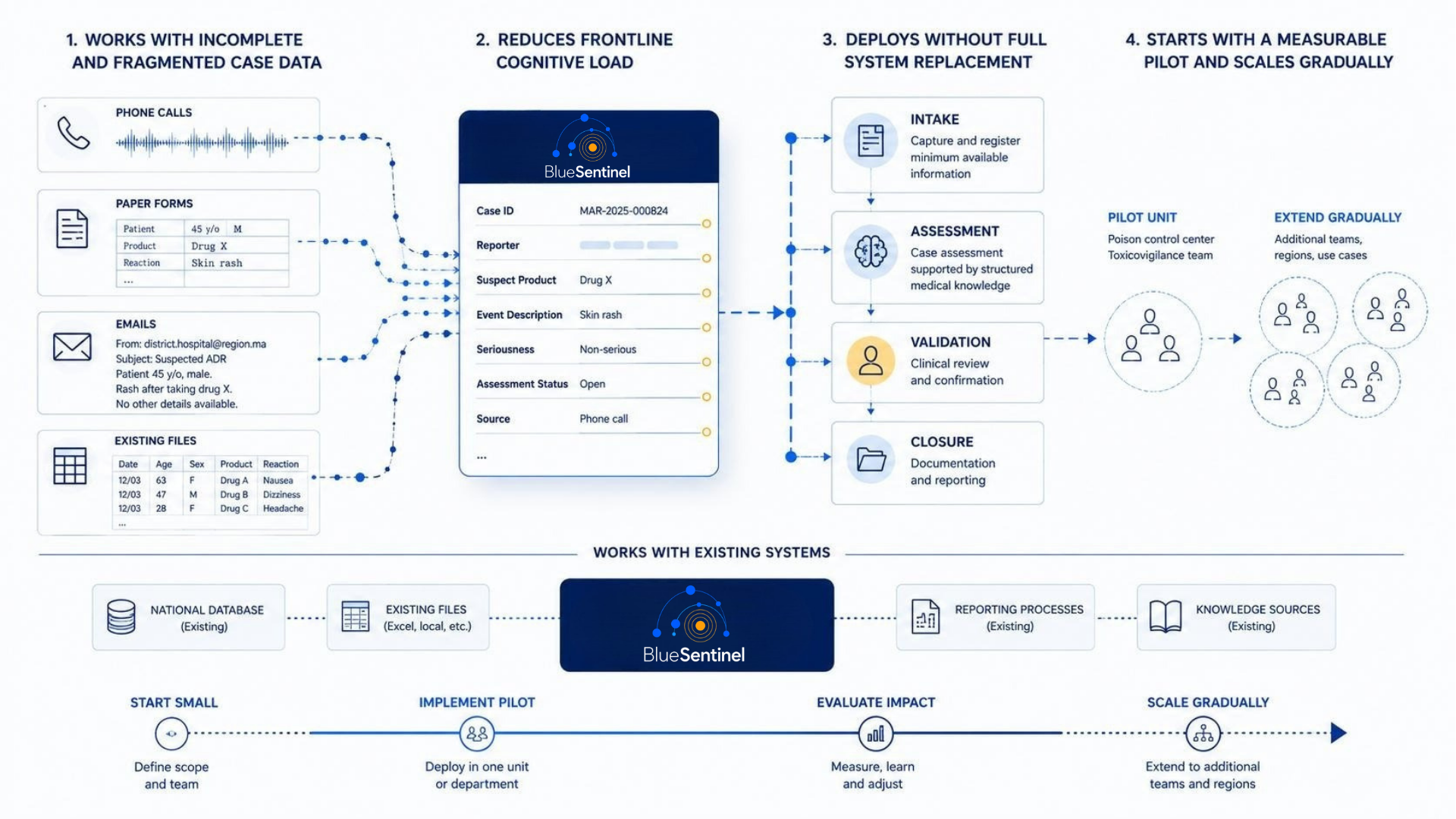
Health vigilance systems are rarely deployed in ideal conditions. Case information arrives through multiple channels. Infrastructure varies. Teams operate under pressure. BlueSentinel was designed with these realities as the starting point.

Works with incomplete and fragmented case data

Case information arrives through multiple channels, phone calls, paper forms, partial digital records. BlueSentinel structures what is available at the moment of intake, without requiring complete data before a case can be opened and managed.

Reduces frontline cognitive load in high-pressure settings

Clinical teams working under time pressure, in understaffed environments, or during emergency response need tools that guide rather than burden. BlueSentinel's structured workflow and AI-assisted assessment are designed to support clinical decision-making at the moment it is most constrained.

Deploys without full system replacement

Implementation starts with the workflows under greatest operational strain, without requiring a complete overhaul of existing IT infrastructure or immediate interoperability with every national system. BlueSentinel integrates progressively, at the institution's own pace.

Starts with a measurable pilot

Institutional adoption begins with a defined, narrow-scope pilot, typically within a single workflow, team, or reporting perimeter. Clear impact indicators and human validation checkpoints at every stage allow the institution to assess operational fit before broader rollout. Scale-up follows evidence, not assumption.

Deployment implementation